When a Parent Disappears SIJS, the Path to Papers Most Families Have Never Heard Of
Maybe you are a grandmother raising your grandson because his father vanished years ago and his mother could not care for him. Maybe your nephew lives with you now because the man who should have raised him never did. Maybe you are a school counselor, and a student just told you something about her home life that you cannot unhear. The child is here without permission. One or both parents are out of the picture, through abandonment, abuse, or neglect. Someone else, maybe you, is doing the raising.
If that sounds like your situation, there is something you should know. There is a path in immigration law built for exactly this child. It is called Special Immigrant Juvenile Status, or SIJS, and most families have never heard of it. It can lead to a green card. But it runs on a clock, and the clock matters, so let me explain it plainly.
Why listen to me
I have handled or supervised more than 500 SIJS cases across California, in Los Angeles, Riverside, Orange, San Bernardino, Kern, Sacramento, Fresno, Ventura, and Tulare counties, and I have trained dozens of attorneys and advocates to do this work. I mention the counties because SIJS begins in state court, and every county’s judges, local rules, and filing culture are different. Knowing how a guardianship moves in Visalia versus downtown Los Angeles is not trivial. It is often the difference between an order signed in time and an option lost forever.
What SIJS actually is
SIJS is a three-step process, and the first step surprises people: it does not start with immigration at all. It starts in state court, usually in a guardianship, custody, or dependency case. A judge must make specific findings: that the child is under the court’s protection or in someone’s court-ordered custody; that the child cannot be reunited with one or both parents because of abuse, neglect, abandonment, or something similar under state law; and that it is not in the child’s best interest to be sent back to their home country. This order is called the predicate order, and it is where real skill matters, because federal officers will later read it closely.

Then comes step two: a petition asking USCIS, the federal immigration agency, to recognize the child as a Special Immigrant Juvenile. The law requires USCIS to decide within 180 days. If it approves, the child is officially in line for a green card.
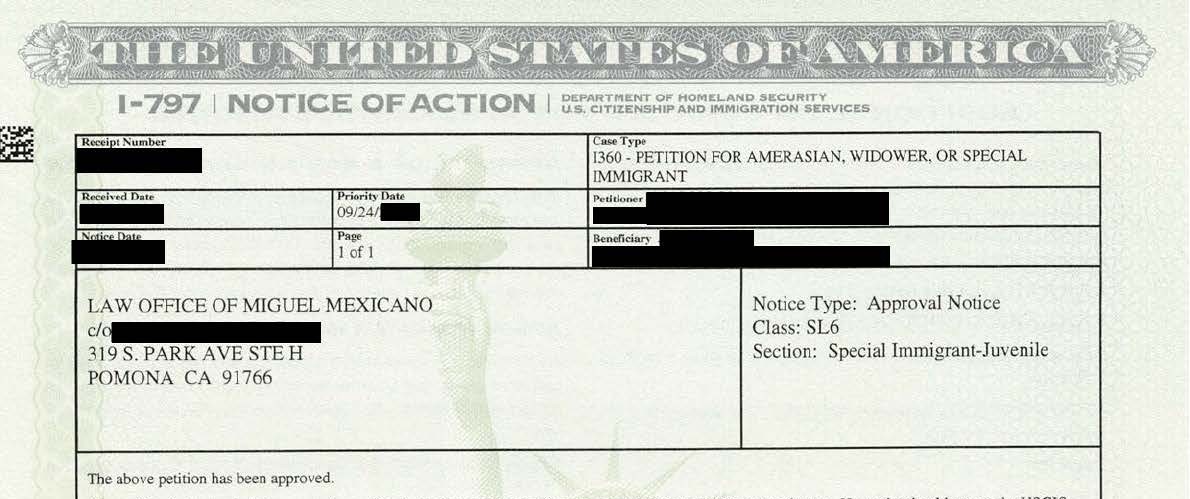
Step three comes later, when the child’s turn in line arrives: the application for the green card itself, called adjustment of status. That is the finish line, and the wait before it is the backlog I explain below.
Does this child qualify?
You do not need to know the statute. Ask yourself these questions instead. Is the child under 21 and unmarried? Is the child here in the United States? Is at least one parent out of the picture: a father who left before the child was born, a mother who sent the child away and cut off contact, a parent whose violence or drinking made the home unsafe? Is someone else (a relative, a family friend, even the other parent) the one actually raising the child? If the answers are yes, the child may qualify.
Notice something important: one parent is enough. A child being raised by a loving mother can still qualify based on a father’s abandonment. That is written into the law.
I think of a girl I will call M., a composite of many children I have represented. Her father left Guatemala for work when she was a baby and was never heard from again. Her mother struggled, and by twelve M. was living with her grandmother in the Central Valley: enrolled in school, doing chores, entirely American in her days and entirely without papers. No one in her family had ever heard of SIJS. Her situation is not rare. It is the typical case.
What SIJS is not
Misconceptions keep families from calling, so let me clear away three. SIJS does not require the child to testify against a parent or confront them; USCIS itself says it will not require the child to contact the parent who caused the harm. SIJS does not automatically mean losing the relationship with the other parent; in many cases the child keeps living with one parent, and the findings concern only the absent or abusive one. And SIJS does not give the child legal status the day you file. It is a path, not a switch.
Why this matters most for children who are not in immigration court
SIJS is not, by itself, a defense to deportation. An approved petition does not close a removal case, and it does not give a child legal status while they wait. What it gives them is a place in line for a green card, and right now that line is years long. A child who is already in immigration court can be ordered removed before their number is ever called: the judge is not required to wait for a visa, and over the past year the immigration appeals board has issued a string of decisions making judges even less willing to pause these cases. Young people in court also face the real risk of being detained while they fight. Good lawyers do fight, and sometimes win, but no family should choose that battlefield if they can avoid it.
But hear me clearly: none of this means a child who is already in immigration court should skip SIJS. The opposite is true. It is far better to walk into that courtroom holding an approved petition than without one. Judges weigh it when deciding whether to close or pause a case, and some judges ask about it directly. And immigration court moves slowly, sometimes for years. While the case crawls forward, the child’s place in the green card line keeps advancing, and if their number comes up before the case ends, the child can ask the judge for the green card right there in court. So the point is not that SIJS is useless in court. The point is that it is strongest outside of court, where the child has time to wait.
That is why SIJS usually does its best work for children who are not yet in immigration court: we can secure the state court order and the USCIS approval, hold their place in line, and let the child wait out the backlog at home instead of in front of a judge. And even a removal order is not always the end of the story, but that is a conversation to have with a lawyer immediately, not a reason to wait.
What SIJS gives a child
A place in line for a green card, and eventually, if they choose, citizenship. Unusually forgiving rules along the way: a child with SIJS is treated as if they had been lawfully paroled into the country, so entering without inspection does not block the green card. Other common obstacles, like the public charge rule and the usual penalties for time spent here without permission, simply do not apply, and many of the rest can be forgiven under a generous standard written specially for these children. That forgiveness reaches further than people expect: a child who missed an immigration court date, or who has other marks on their record, can often ask for a special humanitarian waiver rather than losing the green card over it. And something less legal but just as real: a plan. A family with an approved SIJS petition is no longer just waiting and hoping. They have a case number, a filing date, and a lawyer watching the calendar.
The honest problems
Now the hard part, because I level with people. SIJS is under attack, and the wait is long.
The wait first. Green cards for SIJS children come from a limited yearly supply, and demand has exceeded supply since 2016. As of the July 2026 visa bulletin, the government is only granting these green cards to young people who got in line before September 15, 2022. That is a wait of roughly four years, and as of late 2025 more than 286,000 people with approved petitions were waiting in the broader visa category. During the wait, the approved petition does not by itself give the child legal status.
The wait used to come with a cushion. Starting in March 2022, USCIS automatically considered backlogged SIJS youth for deferred action, which protected them from deportation and let them apply for work permits. On June 6, 2025 the government ended that policy. A federal court ordered it temporarily restored that November, and the litigation continues, but in April 2026 the agency issued a new policy: young people who file on or after May 10, 2026 will no longer be automatically considered for protection while they wait. Case-by-case requests are still possible, and the court fight is not over, but no honest lawyer should promise a work permit today.
Fingerprints are now part of the process too. USCIS schedules biometrics appointments in these cases, and the government has proposed rules to expand that collection even further. For a family without papers, any government appointment feels risky, and I will not tell you that fear is foolish in this climate. I will tell you that we prepare for every appointment together, and none of my clients walks in unadvised.
Finally, the climate itself. In July 2025 the immigration agency’s fraud unit published a report portraying the SIJS program as overrun by abuse. I have read it closely. It leans on arrest counts and “known or suspected” labels rather than convictions, and its central complaint is with a choice Congress itself made when it wrote the law: that abandonment by one parent is enough. That report is an argument for changing the law. It is not the law. SIJS is still on the books, and eligible children are still being approved.
What I do about those problems
I move fast in state court, because I know which counties move slowly. I draft predicate orders with the factual detail federal officers demand, so the case does not stumble at step two. I calendar every deadline against the child’s birthday, not against the court’s convenience. Once the petition is approved, I watch the visa bulletin every month so we file for the green card the first month we can. I screen every child for other, sometimes faster paths to a green card, because some families have options they do not know they have. And before we file anything, I explain the risks in plain language, so every choice is the family’s, made with open eyes.
The clock is real
One more thing, and it is the most important paragraph in this article. This option expires. A state court can only make these findings while it has authority over a young person, and the federal petition must be filed before the child’s 21st birthday, with no exceptions. Every state has its own rules: in California, for example, a guardianship is available through age 20, while in some states the option ends at 18. Getting a guardianship heard, an order signed, and a petition filed takes months, and in some counties longer. Families often wait because they are afraid, or because they hope things will fix themselves. I understand both. But with SIJS, waiting is the one mistake that cannot be undone. This is not a sales tactic. It is arithmetic.
The path is still open
Here is what I want you to take away. If you are raising a child whose parent abandoned, abused, or neglected them, the law has not forgotten that child. The path is harder than it was three years ago, and slower than it should be. But it is real, I have walked hundreds of children down it, and for those who start in time it still ends at a green card. The girl I called M. got her guardianship at twelve, her petition approved at thirteen, and her green card just in time to apply for college.
If you are a school counselor or social worker, call too: I can talk through a situation with you before anyone has to give a name. And if you are the one raising the child, call while the clock is still your friend: 213-685-1890 · www.mexicanolaw.com · We speak Spanish.
This article is general information, not legal advice. Every case is different, and immigration policy in this area is changing quickly. Nothing here creates an attorney-client relationship. Please consult a qualified immigration attorney about your specific situation.